Sunday, March 27, 2011

Q1 Wrap-up

I know it's been ages since I've updated, so I'm just going to outline what I've written over the past couple months.

Why I Hate Red Dead Redemption. I was really proud of this piece as I'd chosen to take on one of the most highly regarded games of 2010. I'm really pleased at the commenters too. I expected to be torn to shreds over it, but it seems like a majority were in agreement with me (to an extent).

Bionic Commando Retrospective. I loved this game so hard. Truth be told, I didn't actually discover it until over a year after it came out when it was on sale for $10 at the local supermarket. Thanks to Brad Gallaway for convincing me to take the plunge.

Bionic Commando Rearmed 2 review. Never mind its short length, this was one of the hardest reviews I've ever had to write. Possibly because my editor, Ryan Kuo, has written for the Wall Street Journal, and I really didn't want to look stupid in front of him. He seemed to like it, so mission accomplished!

Two World 2 review. This was a really fun review. Also a fun game. It's totally rough around the edges, but after the generic first few hours I had a blast with it. To be honest, I actually liked it more than Oblivion (if only just. They suffer from a lot of the same issues, though, but TW2 had more personality, imo).

Spare Parts review. I was pretty "meh" on this game. It wasn't terrible and I actually kind of enjoyed its middle levels, but its so similar, yet inferior to the LEGO games and many of those can be found for about $10 these days.

Doc clock review. This is the worst game I've played this year. I came dangerously close to giving it a 1, but since that's the lowest score possible I figure a game has to offer absolutely nothing to get this. Doc Clock at least offered a good idea and crisp aesthetic, even if its execution was abysmal.

Knights Contract review. One of the most disappointing games I've ever played. As a cross between Bayonetta's crazy-go-nuts action and Enslaved or Ico's partner mechanic it looked like a winner. Unfortunately, its repetitive action, poor AI, and immensely frustrating QTE's made it a chore. For shame.

De Blob 2 (DS) review. This game wasn't great and I only barely gave it a 3, but what was there was perfectly pleasant and enjoyable. A bit costly for what it is, but it would have made a fine iphone game at a cheaper price point. Still a good kids game once it goes down in price.

Beyond Good & Evil HD review. This classic still hold up... mostly. I remembered it being pretty cheesy at times, but all the praise it's gotten since release made me think I'd remembered it wrong or was being too harsh. Nope, the script mostly sucks. Great design though, and I love Jade.

Yakuza 4 review. The Yakuza series is one that I want to love more than any other. I find them absolutely fascinating and ridiculous and wonderful, BUT, and it's a big but (hence the capitalization), I find them rather tedious to actually play. Sure you can do a lot of crazy mini-games, but most are confusing, boring, or both. This game reminds me a lot of Deadly Premonition where it's interesting to dissect, if a chore to play. I just happened to like DP's story and world more. Still, I'm definitely glad I played it as I've thought about it quite a bit since then.

Swarm review. I liked this game quite a bit and was very, very close to giving it a 4. The frustration factor and learning curve were just a bit too high for me, but I'm curiously compelled to go back to it if I ever find the time.

The Dishwasher: Vampire Smile review. I loved this game. At first I wasn't so sure as it just seemed too button mashy, but like all the best brawlers, it gets better on harder settings once you get into the minutia of its combat. I'm actually jonzing to play it some more. Gotta wrap up that Samurai Mode playthrough.

The rest are all my columns at Gamasutra

Scare Tactics - How Horror Games Have Evolved Their Controls - I examine several horror games over the past decade or so.

The Notebook - How Zelda's Notetaking Gives Handheld Inspiration - Why I love 2.5D Zelda on a touch screen.

Have it Your Way - Tailoring a Game's Difficulty to Players - The trials and tribulations of giving players options, but not overwhelming them. I don't envy designers on solving this pickles, but there are some neat workarounds that I discuss.

Sexism in Female AI Partners - For the record, I didn't find any of the games mentioned in this article offensive (except for maybe Knights Contract). I just find the overarching trend worrisome. There's a difference. That won't stop a lot of angry dudes from getting pissed in the comments section, though.

I've got a lot more coming soon including some reviews that have been submitted and will go up any day now.

Wednesday, January 19, 2011

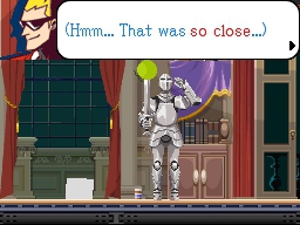
Additional Thoughts on Ghost Trick and its Use of Text.


My review of Ghost Trick is up at Paste. I wanted to address a couple things that I mentioned in the review, but didn't want to lose focus by ranting about. Notably its use of text.

Roger Ebert has a saying that "No good movie is too long and no bad movie is too short." I have a similar feeling about text in games. There's no "right" amount. What matters is what's in the text and if it's interesting. In most cases I'd say Ghost Trick's text is captivating with an intriguing plot and great characters. However, all too much of it is dedicated to redundant exposition of stuff you've already been told or pandering hand-holding.

This is especially irksome in the puzzle stages where you should be able to just have at the environments and go about your ghostly business, but are instead interrupted every two seconds by someone explaining what your actions mean or spouting out an obvious hint. This is extremely irritating as it not only impedes upon the puzzle solving, but ruins the pacing as well. There's also a lot of repeated text as you'll hear the same hints every time you perform specific actions. This can be sped up, but not altogether skipped. Very annoying.

Otherwise, I had no problem with Ghost Trick's talky nature. The plot was convoluted, but holds up well the more I think about it. I absolutely adored some of its twists and must give credit to Takumi and the translation team for dropping such subtle foreshadowing throughout. It really is a great story. It's just a shame I had to put up with such irritations to get to it.

I had a lot of the same problems with Phoenix Wright as well, but was hoping Ghost Trick's more traditional point-and-click puzzle mechanics would break free from the mold a bit more, so I could enjoy Takumi's great stories without the highly scripted hand-holding design. Sadly, that was not the case.

__________________________________________________________

Oh, and here's some other stuff I've written lately:

ilomilo review - The first 5 star review I've given at X-Play. I had a feeling it would be good, but no idea it would be THIS good.

Raskulls review- I didn't care for this one so much, but it had some good ideas.

I Don't Know What Came Over Me - Analyzing the relationship between playable characters and the players who inhabit them.

Epic mickey's Epic... Success - Why I loved EM despite its major flaws. Focuses on how it achieved its goal of getting me into oldschool Disney animation.

Wednesday, December 29, 2010

Best of the 2010: The Rest


As the holidays are quickly coming to a close and my work load is about to increase, I've decided to be a lazy bum and condense the rest of my faves from 2010 into one post. Without further ado, I bring you The GAMES of 2010!!!

In no particular order...

Epic Mickey
I've written about this one a lot -- and not always favorably -- but if you can get past that your playstyle doesn't matter as advertised, it's still a wonderful linear platforming adventure. The world and characters has more charm than just about anything I played this year, the story was fantastic, I found the moment to moment gameplay compelling, and it was up there with Nier as having the best soundtrack of the year. Not quite the masterpiece I was expecting, but a noble effort that really stood out to me.

Nier
The second most original game I played this year (next to Deadly Premonition). It doesn't do any one thing new, but its constant shifting of genres and tones made it feel extremely fresh all throughout. Characters are extremely memorable and don't fall victim to the usual stereotypes we see in these sort of games, and there's at least half a dozen fascinating vignettes placed throughout. Few games this generation have managed to consistently surprise and delight as well as Nier.

Deadly Premonition
The most moving game I played this year. It's rough as all hell with terrible combat and driving mechanics -- making it one of the only games I'd recommended having an FAQ handy for -- but if you get past some poor mechanics it's got a good story and probably my favorite protagonist in any game, ever. Francis York Morgan has stuck with me all year and I expect will stick with me for years to come. Deadly Premonition's unusual brand of offbeat humor and disarming melodrama make it stand out among anything else I've played in years. It's not "so bad it's good," as some reviewers have claimed, but genuinely fantastic.

Castlevania: Lords of Shadow
I know a lot of people have written this off as a God of War clone, but I thought it was better than that series in almost every conceivable way. The combat system, the biggest component of the game, was head and shoulders better than that in Kratos' swan song. I loved the light and dark magic mechanic which really encouraged players to vary their attacks. Elsewhere, it had great pacing (after the first couple chapters anyway) with an increasing focus on puzzles, marvelous atmosphere and art direction, and an epic scale. The storytelling was perhaps the only weak link in this otherwise grandiose action/adventure.

Vanquish
I reviewed this one over at Gamecritics. I don't have much to add that isn't in the review, but I'll just say that I don't usually like cover shooters, yet Vanquish managed to subvert that into a very fast-paced, tactical, shooter unlike any I've ever played. We've seen cover, slow-mo, and sliding before, so why did it take so long for someone to combine them?

Tales of Monkey Island: Season 1
Okay, so this came out last year, but its definitive console port on PSN came out this year and that's how I played it. I've not played a point-and-click adventure since Grim Fandango that's lived up to how I remember them being in my youth... until now. Not perfect by any means, but it got all the charm and whimsy of the Monkey Island series spot-on and more importantly showed me that I still have the patience and passion for these games that I thought I'd outgrown.

Super Mario Galaxy 2
I never expect to like these first party Nintendo games so much. Every time one comes out I think I've outgrown such shallow silly games, but when it's done right there's nothing else quite like it. SMG2 is hands-down the most fun I had with a game in 2010. While it's easy to write off as not very innovative, I'd argue that practically every level has some new idea in it. There's no major surprises -- it doesn't all of a sudden become a text adventure (like a certain game on this list starting with an N) -- but the devil is in the details, and every little facet of Mario's second romp around the cosmos is filled with unexpected goodness.

And to be comprehensive, I already wrote about Donkey Kong Country Returns and Bayonetta. I guess that makes it a Top 9. Beyond that, there's a few other standouts including:

Super Meat Boy - Very fun platforming goodness. I loved it, until I could take its abuse no more.

Limbo - Best graphics of the year, imo. Very stylish, well designed platformer/puzzler. I wanted a little more narrative depth, but hey, that's just me.

Enslaved - I'm still a bit peeved at this one for some major plot holes at the end, but it's otherwise got some of the best characters and art direction I've seen in a game this year. Really great time all around.

Bioshock 2 & Minerva's Den - I feel like Bioshock's gameplay has grown rather stale, which is why these aren't higher, but they otherwise both feature some really outstanding stories and end on a high note (unlike the first Bioshock which started strong and ended with a whimper).

Lara Croft & The Guardian of Light - I don't think anyone expected this. I for one still like Tomb Raider, but making it co-op and top-down seemed to defeat the purpose of exploring a 3D environment. Then I played it co-op and it had some of the best 2-player puzzle design I've seen.

There you have it. There's plenty of games this year that I didn't get to play (Amnesia, Kirby's Epic Yarn, Minecraft, etc...) so it's by no means a definitive list, but this is what stood out to me. May 2011 be as full of surprises. Happy New Year and happy gaming!

Friday, December 24, 2010

Best of the 2010: Bayonetta


While I've always liked third-person hack-and-slash games, the Devil May Cry series has always held a special place in my heart for its unique blend of melee and ranged combat. Going back to God of War or Ninja Gaiden, which focus almost exclusively on the former, just felt tame and flat in comparison. Bayonetta, from Devil May Cry creator Hideki Kamiya, is very much the successor to that series taking what worked (guns + swords) and sprucing it up with a better camera, bigger bosses, and zanier setpieces.

The result is Devil May Cry on crack. It doesn't stray far from the formula, but so what? It's a great formula. Combat is quick with incredibly deep customization so you can alter it to your particular playstyle. I'm perhaps not the most experimental with this sort of thing, but I still found myself using more weapons than I usually do in this sort of game.

Then there's Bayonetta herself, the somewhat controversial overtly sexualized ass-kicking nun. Some find her insulting or pandering, but I found her empowering (I also didn't find her sexy, for what it's worth). She's flirty as all hell, but not in a way that's pandering to the audience. Being flamboyant is just part of her personality and her winking at the camera to me says less "come hither" and more like a teasing "keep up with me if you can." She's a handful, that one.

It wasn't perfect though and there were a few painful flaws that I never see anyone point out, so I will. Checkpoints are too generous, often appearing multiple times during a single boss fight. Dying simply sets you back at the last checkpoint with full health, so you're practically encouraged to get a game over when the next phase of a boss battle begins. Unless of course you're going for a high score, but if that's the case, the game fails as well by making levels far too long with insta-kill quick-time events that are sure to ruin your streak. And finally, the game's central mechanic, witch time (slow-mo executed by a well-timed dodge), is disabled in harder difficulties. Other equipment netting counter-attacks for successful dodges make up for this somewhat, but it's still disappointing they couldn't have found a way to make the game very hard, yet still grant one of the game's best features.

Flaws aside, Bayonetta was the most fun I've had with an action game since Devil May Cry 4. I played through it three times in as many weeks and writing this makes me want to play it again right now.

Wednesday, December 22, 2010

Best of the 2010: Donkey Kong Country Returns

In honor of the year winding down I've decided to recap on some of my favorite games of the 2010. I'm not going to do a top 10 list per se, as I find it futile to rank such diverse offerings, but would rather dedicate a short blog post to each game that really meant something to me this year. So today we'll start with...


Donkey Kong Country Returns.

I wasn't that excited for this one initially. My memory of Donkey Kong Country is foggy at best, having only rented it when it came out a decade and a half ago. I remember liking it at the time, but given my age it didn't take a lot to impress me. Prior to DKCR coming out, I'd assumed that the series was mostly known for its graphics, not gameplay. There was nothing I could gather from trailers or my time with it at trade shows that made me think DKCR was anything more than nostalgia for nostalgia's sake and that a recreation of our early childhood memories wouldn't hold up in the modern era.

Still, My girlfriend was a big fan of the series, though, so for that reason alone I decided to take the plunge and check it out.

And boy am I glad I did! Initially, it didn't do anything to change my preconceived notions. There was nothing particularly innovative about jumping, swinging, shooting out of barrels, etc... But what I hadn't expected was just how fun it would be. Controls are tight and responsive, levels are lush and gorgeous, and the cute animals are genuinely cute. Like really, really cute. The way Diddy runs over a rolling Donkey Kong still fills me with delight every time I see it.

It's also plain exciting. There's a real momentum to some of these sequences as the levels crumble behind you as you desperately try to acquire the hard to reach KONG letter. It's definitely challenging, but rarely frustrating with frequent checkpoints and a liberal dose of lives.

Co-op was fun too. It's not perfect and you'll hemorrhage lives this way, but they're not hard to replenish. Playing through the campaign with my girlfriend was seriously one of the highlights of the year for me in gaming.

Once we'd completed it I asked her what she thought. She said she liked it, but was a bigger fan of the older games. My memory is too rusty to accurately compare, but I'll say that it effectively captured the feeling I got when I was 12 and a 2D platformer needn't be innovative or deep for it to be just about the best thing ever.

_______________________________________________

And for record keeping purposes, here's some stuff I've written over the past few months:


Defying Design: Dead Lines Rising. On how time limits can enhance or hinder an experience. Looking specifically at Dead Rising: Case Zero and Majora's Mask.

Defying Design: Cloak & Dagger. A look at competitive stealth-based multiplayer.

Defying Design: New Moon. On what makes a good reboot. Looking specifically at Castlevania and Silent Hill.

Defying Design: Gaming up the Wrong Tree. Analyses of games that misdirect the player from their true goal.

Defying Design: You Bet Your Life. A look at the role of luck in action game.

Defying Design: The Buddy System. How co-op has evolved in 2D platformers over the past few years.

Defying Design: Epic Mickey's Epic... Failure? How choice works, and does't work in Epic Mickey.

Tuesday, September 28, 2010

Gaming Literacy

The charms of this game were lost on me. I should probably revisit it.

I was listening to the most recent Experience Points Podcast with one of my favorite writers, Michael Abbott as their special guest talking about how he recently had Portal added to the list of required for a freshman course at Wabash College where he teaches.

During the discussion, the concept of gaming literacy came up and I wanted to throw my own two cents into the mix...

It may seem odd now being the seasoned gamer that I am, but I recall struggling a lot with Ocarina of Time when I first played it about seven years ago. Embarrassingly, the things I struggled with would seem like common knowledge to any gamer now, yet confounded my rusty 16-bit gaming mind.

When I'd played Ocarina I was 20, just bought a Gamecube, and hadn't owned a console since the SNES. Gaming was a mere curiosity to me at the time, as I wondered what had become of my favorite childhood pastime. Little did I know how hard it would be to get back into.

I recall first getting stuck in Ocarina when told to head to Hyrule Castle. I went up to the gate, a guard told me I wasn't permitted on the premises, so I left. Given my background in point-and-click adventures I naturally assumed I needed permission before entering. I scoured the land far and wide talking to everyone, hoping someone would give me the proper documentation to enter. Inevitably I gave up and consulted an FAQ. The answer; I was supposed to sneak past the guards -- something that would have never occurred to me as I'd not had to do that in a Zelda game before.

Granted part of this was due to a technical limitation. Guards have unrealistic eyesight in that they're incredibly near-sighted and standing a scant 20 ft in front of them is considered being out of range, even if it looks like you should be clearly spotted. I chalked this up to me being a dunce and pressed on.

My next point of contention was not understanding that my fairy, Navi, doubled as a hint system. After Hyrule Castle I kept wandering without a clue as to where to go. Navi kept interrupting, saying that she wondered what my possible girlfriend back home would think of me now. Looking back on it it was obvious; she was telling me to go back home where I'd discover a new event that would drive the plot along, but I somehow thought that this was just cutesy dialogue meant to add flavor to my fairy companion. "Yes, Navi, I get it. I'm the hero of time. My g/f will be impressed. Whatever. But where am I supposed to go?!" Much like the castle, it wouldn't have occurred to me to go back to the starting village as I thought I'd already done everything there. Whoops!

And don't get me started on hitting A to take out/put away your sword. Apparently that doesn't matter as hitting B will perform an attack regardless, but it took me most of the game to figure that out as I constantly cursed the screen every time I'd accidentally sheath my sword when trying to read a sign.

It's easy to forget about these barriers to entry having played so many games, but I still find it fascinating what parts of videogame knowledge we simply take for granted. Let's hope Wabash's incoming class is smarter than I was (or that Portal is more intuitive than Ocarina. Which I imagine it is).

______________________________________________________________

Here are some things I've written lately:


Blade Kitten review for Joystiq

And I've continued my Defying Design columns here:

Smooth Talk; the evolution of dialogue trees using Monkey Islands' present and past as a base.

Alternate Perspectives; examining how Nier only told its story through multiple playthroughs and the potential benefits and pitfalls to such an approach.

I Have No Mouth and I Must Save the World; about the pros and cons of silent protagonists, and examples of those that work best.

Altered States; analyzes the effects of moral choices on character design and how it can influence playstyles.


On a side note the Eurogamer piece was a major win for me as that was the site that initially got me interested in pursuing videogame journalism professionally. I can still acutely recall Penny Arcade linking to Kristan's Prince of Persia: Warrior Within review, which I thought was exceptionally well written. I liked it so much that I started perusing the site further and it soon became my go-to for game reviews and previews. This isn't to say that other sites aren't equally great or anything, but EG was my original inspiration and continues to hold a special place in my heart.

Friday, August 13, 2010

DeathSpank is Fun for all the Wrong Reasons


I'd heard DeathSpank was rather Diablo-ish going in, but my only experience with Blizzard's RPG was the scant demo I played of it half my lifetime ago. I barely recall it, but if memory serves correctly you merely pointed on enemies and your avatar fought them automatically, trading blows until one party fell. The skill came from deciding what equipment to use and stat buffs to utilize. One could still heal and use items mid-battle, but by and large, you had no active control in the combat. Of course, this is all speculation based on my memory of a 14 year old demo. But it's still what I think of when I think of Diablo.

DeathSpank looked a lot more enticing to me. I was mostly interested because of Monkey Island creator, Ron Gilbert's* involvement, but on a mechanical level the combat looked far more responsive. You could attack in real-time, block, and do all the things one would expect in a hack-and-slash action game. In short, aside from the loot-collecting, it didn't resemble my foggy memories of Diablo the way I expected.

So it was with a bit of disappointment when I played the game and soon realized it fell a little flat on the two things I was most looking forward to; the writing and combat.

The writing is certainly above average and traces of Monkey Island can be found all over the place, but I can't help but agree with Sparky Clarkson's assessment that while the game cleverly personifies its protagonist's world view, DeathSpank isn't a very interesting protagonist. Clarkson goes on to say that Gilbert did the "moron-hero" thing better in Monkey Island, but I'd argue that Guybrush Threepwood was never a moron. A wimp, certainly. And lacking certain social skills around women, sure. But not a moron. He was often clever, cunning, and aside from physical stature, really did embody the crafty skills his dream profession required. DeathSpank, however, is a moron. He's just a one trick pony. His one defining characteristic is that he's stupid, but thinks he's amazing. Guybrush too thought himself a mighty pirate, but the difference is that Guybrush had pathos. We felt bad for him as he tried to woo his love interest, an often sought after tomboyish governor. Everybody roots for an underdog and that's what Guybrush is. DeathSpank, however, is beefy and foolhardy enough to complete his quest, so there's no sense of overcoming the odds. Or maybe I'm just a sucker for a good romantic subplot. Either way, I don't care much for this guy.

That being said, the jokes hit more often than miss and there's a lot of charm to be found in the game. It's just not as consistent or endearing as his earlier work.

I want to get back to the combat though, as my reaction to it was the most surprising thing. Going into it expecting more of a skill-based hack-and-slash, I was disappointed. The enemies cluttered the screen too much, I could never tell when to block, and even when I could block successfully I'd find enemies chipping away at my health without being able to tell that their blows were connecting. It was messy, sloppy, and dare I say, broken as an action game. Here's the weird thing; I didn't mind.

Despite having direct control over your avatar, combat is much how I remember Diablo. It's so imprecise that you'll end up trading blows with the opposition no matter how honed your reflexes are. You can't take on high-end enemies at first, but must be at an adequate skill level before you have any chance at success. It's ultimately just an excuse for you to kill things, gain new levels and equipment so you can take on bigger enemies, kill them, and gain even more levels and equipment. It's everything that I claim to hate about lazy, padded design.

And yet I like it. I like watching the numbers go up and my character getting stronger. I'm sucked in in the same way that's always alienated my from RPG players and I can think of two reasons why.

a.) DeathSpank is very well-paced. It seems as though I gain a new level or a better piece of armor or equipment every couple of minutes, so I'm never wasting a significant amount of time with negligible progress.

b.) DeathSpank is short. A vast majority of RPGs I've tried I've given up on after about a dozen hours. The few I've completed were rather slow-going by the end and I really had to force myself to push on. Admittedly I'm only 9 or so hours into DeathSpank and I'm sure that if it were a 30+ hour game I too would tire of it long before the end credits roll. Thankfully, it's not. I've discovered 23 of a possible 30 outhouses (respawn points), so I'm going to assume I'm about 3/4th through and thus have another 3-4 hours left. That sounds about perfect to me. As soon as I'll start to tire of the grind, I'll be at the end and ready to move on to something else. And it only cost $15, so I don't feel cheated about length which I know is a concern for RPG veterans who like longer games.

Ultimately, DeathSpank doesn't fire on all cylinders for me, but it fires on the ones I least expected. I still maintain the the premise was flawed and wish it was more Monkey Islandesque when it comes to puzzles. Though for a genre I always looked at from a distance and could never quite understand the appeal of, DeathSpank is a wonderfully accessible entry.


*Note: One of my most embarrassing experiences as a journalist comes from when I asked a friend at Hothead studios if she could introduce me to Ron Gilbert. She took a step forward, interrupted his conversation and said, "Hey Ron! This guy wants to meet you!" Horrified, I cowardly thanked him for Monkey Island, then snuck away with my tail between my legs.

Wednesday, July 21, 2010

New Column and Some Monkey Island Love

I'm sorry it's been so long since my last blog post, but things have been hectic. I went to E3 which I meant to write a lot about, but instead found myself exhausted after the convention, Disneyland and Magic Mountain (not in that order). Long story short; E3 was fun, Disneyland was moreso. Epic Mickey looks to be a happy medium, but still no substitute for actual being there. Okay, now I'm getting weepy over Disneyland withdrawals so moving on...

The big news is that I've stopped writing Challenging Conventions at TGR (nooooo!!), but started writing its spiritual successor, Defying Design, at GameSetWatch (yaaayyy!!). Think of it as Challenging Conventions 2.0. The first edition is about what makes a game scary as well as suggestion on how to make current more action focused horror games scarier.

Other than that, I've been on a big Monkey Island kick. While I was buried deep in announcements at E3, Tales of Monkey Island was released on PSN unbeknown to me. I'd always wanted to play it, but I didn't have a PC up to snuff and heard lackluster things about the price-hiked Wii port. Stubbornly, I held out in hopes of an XBLA or PSN port and over half a year later my prayers were answered. The PSN version looks great and runs like a dream. Better yet, it's a great game in its own right and while it has its flaws, it improves upon the series in a few meaningful ways. I'd tell you what they were, but may save that for a column;) Just know that despite its lackluster first couple chapters it gets better and by the end I cared about the cast more than I ever have before. Ultimately, it's a worthy chapter in the saga and the first traditional adventure game I've played in over a decade that I'd consider a real return to form for the genre.

So enamored was I that I picked up the special editions of Monkey Islands 1 & 2 and am playing through them now. I had some issues with the presentation and interface of the first special edition and found myself regularly switching between old and new, but so far I'm really blown away at how well they've adapted Monkey Island 2. The new look is lush and vibrant, and the animations smooth. The voices and music are top notch as well and I love what they've done with the interface. I'm only a few hours in so far, but color me impressed!

I also played Limbo and reviewed it for TGR here. As you can tell from the review I liked it quite a bit, but found myself perplexed and befuddled by the end. It's either brilliant and I'll prove myself a philistine for not getting it, or it really does have no story. I look forward to discussing interpretations with others upon release (which is today. Go out and buy it!).

Anyway, here's some other stuff I've written lately:


Challenging Conventions # 16: Bite-Sized Gaming This was my final CC piece. It was about how most of the games I got excited about at E3 were digital downloads which tend to be cheaper, smaller, and exhibited a greater degree of creativity. On a side note, I think a lot of people were disappointed by E3 this year (where was The Last Guardian?!), and while there was no huge new game that got me excited (Zelda was particularly disappointing) I walked away feeling like I'd seen a lot of great stuff particularly from the downloadable market. Forget Kinect and move, this is the part of the industry that has me most excited.

Note: Forgive me if I don't update again soon. I'm moving house in a couple weeks, so I'll be pretty busy and without internet access for a few days.

Wednesday, June 9, 2010

Super Mario Galaxy 2 and Other Goings On...


My background with 3D Mario has been spotty at best. Not having owned an N64 in its heyday, my first foray into Mario's 3D adventures was the underwhelming Super Mario Sunshine. I liked it alright, but found controlling Mario in a 3D environment to be cumbersome. With so many different types of jumps and a controllable camera to manage, it was difficult for someone coming off 2D gaming to gauge depth. I also found the repetition of environments and tropical aesthetic tiresome. As far as 3D platformers went, I much preferred Sly Cooper's exploits.

I eventually got around to trying Mario 64. By an odd stroke of luck I acquired it for the DS and N64 on the very same day. I gave the N64 version a shot, decided I'd rather play a newer game at home and save Mario 64 DS for being out and about. From the little I gleaned of the N64 version the analogue stick helped, but didn't make the game. Ultimately, I found Mario 64 DS to be a step up from Sunshine in terms of variety and creativity, but still awkward to control and not nearly as much fun as its 2D ancestors.

So it should come as no surprise that I wasn't all that excited for Super Mario Galaxy. The use of motion controls were still novel and I was curious to see them implemented by the big N itself, but otherwise I was expecting a pretty good albeit unrevolutionary 3D platformer. I couldn't have been more wrong.

What changed my mind, you ask? Well, it wasn't any one thing, but a variety. Capturing star bits with the Wiimote pointer while otherwise controlling Mario with the analogue stick was a neat addition, as I felt like I always had something to do even when backtracking. I admired its unique spin on gravity and how it downplayed traditional platforming in lieu of spinning and interacting with the environment. Mostly, I loved how much variety it had on display with multiple objectives in the same galaxy taking you to wildly different places. I could go on and on, but others have sung its praises endlessly in reviews all across Metacritic. The point is that it gave me the sense of wonder and excitement that most people had for Mario 64 that I probably would have shared had I been into games at the time.

That being said, I was skeptical of Super Mario Galaxy 2. It had only been 2.5 years, and the trailer looked like more of the same. And in many ways it is. My initial reaction was underwhelmed. There was nothing wrong about it per se, but they set the bar so high two years prior that I'd already expected excellence. It had to go beyond that.

Eventually it did. There were more novel ideas thrown out faster than Yoshi after eating a flaming hot pepper and I found myself hopelessly addicted to collecting stars in a way I hadn't been since the last Galaxy. But where this one positions itself superior is in its lasting value. Just when I'd achieved 120 stars another 120 hidden ones opened up. One gripe- I wish these had been there the whole time as replaying earlier missions isn't always that exciting. Still, the great thing about the hidden stars is that they encourage you to explore each level to its fullest, often achieving tricks you never thought possible. It's a wonderful reward and certainly more fun that simply unlocking Luigi (who's also in this one and unlocked much earlier on).

SMG2 may not have stirred my imagination quite the same way as its predecessor did a couple years back, but it doesn't matter. It tapped into my OCD in a way that most games attempt to, but fail miserably at. If I'm not consistently making progress, being challenged, and discovering new things, I move on to something else. SMG2 has it's flaws (the swimming and repetition of the Bowser boss battle is a particularly irritating flaw as it's been true of almost every 3D Mario game, yet never been fixed) but it understands pacing perfectly making it my favorite game of 2010 so far.


Oh, and here's what I've written over the past couple months...

Nier Review- I liked the game a lot and meant to write on it more. Perhaps I will...

Zeno Clash: Ultimate Edition Review- I didn't like this one as much, but it had its own charms.

Challenging Conventions# 12 Anticlimax is the New Climax- Games the buck the status quo of ramping up their difficulty for the endgame.

Challenging Conventions# 13 Graphics So Bad They're Good- An analysis of some games where the poor graphics actually enhance the experience.

Challenging Conventions# 14- A look at poor writing in otherwise great games and how at the end of the day fun is fun. But that won't stop me from asking for more.

Challenging Conventions# 15 What's the Hurry?- A look at fast-travel and how it can at times be detrimental to immersion.

Note: I previously believed Challenging Conventions# 14 to not exist as it wasn't showing up in the TGR search engine. Turns out the editor abbreviated it CC and it was nearly lost to the ether. Somehow I didn't remember writing it and thought I'd miscounted. I'm glad it's back and in its full glory.

Saturday, April 17, 2010

Still Alive

After a several month hiatus, I'm bringing the blog back. It's been fun living my life, enjoying time with my beautiful girlfriend and all, but after awhile I started to feel like I wasn't contributing enough to the game space, instead squandering my (admittedly long-winded) thoughts to cryptic messages on twitter. To which I say, nay to 140 character limit. This is my space to unwind my thoughts. If not, what am I paying $15 a year on this domain name for?

I can't promise I'll update this often, but I'll try. I think the problem I was running into before was that I was saving my best ideas for published articles and worried I'd squander them here where I'm not getting paid, they're not getting published, and fewer people would see them. Furthermore, I was stressing too much over my other articles so the thought of writing in my free time sounded extra stressful. But one of the greatest advantages of a blog is that you don't have to worry what other people think or if your current article is making the grade. So here I'm just going to throw out random thoughts I have that maybe don't fit into other articles, yet still cycle through my head whenever such topics are broached.

So, without further ado, here's some links to stuff I've written followed by (drumroll please) a new entry!


Challenging Conventions# 10 How Bioshock 2 deals with Fatherhood Better than Heavy Rain

Challenging Conventions# 11 Playing Hard to Get- My take on Pixel's decision to make so much of Cave Story's best content an obscure secret.


The game I'm loving more than anything on the planet right now is God Hand. Yes, it's over 3 years old, on the PS2, has terrible graphics (even for its day) and scored mediocre critical reception. But I don't care. I love it.

Why do I love it? That question is a bit more complicated. Firstly, the game is extraordinarily fun. With all my highfalutin musings on innovation and narrative, at the end of the day, I mostly just want to have fun. At least that's where I'm at right now. Maybe by summer I'll be bored of fun and want something heady again. But I digress. Right now I just want to kick some ass and zone out on something that dazzles my mind and reflexes. And when I say mind, I mean that I'm constantly thinking while playing. Combat is a puzzle, in a sense. It takes quick thinking coupled with reflexes, contrary to the cliche that action games are mindless. It's rather that the type of mental engagement they provide is fleeting. It's not going to change my outlook on life or anything, but when I'm punching dudes and spanking women, I'm certainly not thinking about anything else. And there's a lot of value in that. It's meditative.

But this is true of any action game. What makes God Hand special is just how unique it is. The controls are just plain weird. Instead of learning new combos, you build them by buying moves and setting up your own. In essence, you get to write your very own symphony of destruction. It's a wonder why this idea of creating one's move set never caught on with other action games beyond simple weapon switching.

Character movement is especially alien. The game utilizes RE4 style "tank" controls, where the main character can't strafe and the camera is always locked behind them. There's even a 180 degree spin move like RE4. This should come as no surprise as God Hand was directed by RE4 director, Shinji Mikami, who also created the very first Resident Evil back in the day. Say what you will about those games (personally, I hated RE0 so much that I never tried any of the other early titles, but loved RE4), but you can't deny their impact on the industry. I find it fascinating that after the critical and commercial success that RE4 was met with, Mikami followed it up with this, which in turn no one bought. While the controls are unusual to say the least, Mikami clearly had an original idea as to how a brawler should control, yet it was rejected because it didn't have a controllable camera, jump button, or lock-on- ya know, things that critics at some point decided all third-person action games should have. Admittedly, God Hand's controls do have their quirks, but I find it no harder to control than other action games of its ilk (and indeed easier than the God of War series with its long, unbreakable attack animations) and it just feels so refreshing after years of god of War and DMC clones.

The game isn't deep at all, the story makes no sense, the dialogue waffles between hilarious to cringe worthy, but the sheer madness of it all combined with such excellent combat have made it my go-to game for the past few days. Mikami has said that he made the game just for him and since it failed commercially, he's trying to make his next game, Vanquish, appeal more to Western audiences. I can't say how much it hurts me to hear him say that. Then again, RE4 was a more Western direction for that series and it worked splendidly, so there's no reason to give up hope yet. I just hope he doesn't sell his soul in the process, because God Hand, it's nothing but soul.

Friday, March 12, 2010

More Things I've Written

Holy crap it's been a long time since I updated this thing. I was going to post a series of plot holes I noticed from Heavy Rain, but then read at least three other articles doing the same, covering largely the same ground. So instead I'm just going to archive some stuff I've written over the past two months. If you enjoyed my earlier Jumping Moustache editorials, check out the Challenging Conventions columns. Don't tell Sinan (TGR features editor), but they're basically my excuse to have a published blog on topics I would have written about anyway.

No More Heroes 2 Review

Endless Ocean 2 Review


Challenging Conventions# 6: The Likable, Mass-Murdering Hero- On less lethal alternatives for action-adventure games that don't break character.

Challenging Conventions# 7: Taking Stock of Mass Effect 2- The pros and cons to Bioware's more streamlined approach and what it means for the industry.

Challenging Conventions# 8: The Transparency of Mass Effect 2- Seriously people, Mass Effect 2 is NOT the greatest game ever. Though it is very good. Here's some things I found not-so-good about it. Not nitpicking so much as giving constructive criticism. It worries me when a game like this gets praised to the heavens, as I fear that its legacy of flaws will live on in the game industry under the philosophy of "Mass Effect 2 did it, so it must be good."

Challenging Conventions# 9: Heavy Rain fails to Understand what Interactive Drama Means- I did not like Heavy Rain. I did not like it for a multitude of reasons (as seen in my review). This article, however, focuses entirely on the design aspects and how Cage drops the ball on making the interactions meaningful.


Otherwise I've been playing a lot of Demon's Souls. It took awhile to really "click" with me, but it now might be my favorite game from last year. No, really. More on that later...

Monday, January 4, 2010

Challenging Conventions Retrospective

I've been doing a rather poor job of keeping up with this blog, but figured this would be a good time to link to my most recent Challenging Conventions columns as let's face it, wading through the TGR archives can be cumbersome at best. Thankfully, I am here to provide the necessary links. In this case, at the end of the great year that was 2009, I wrote about my three favorite games of that year in a row. Lucky me!

Here's a piece on Uncharted 2, and why its pacing makes it such an unusual and memorable game.

And this column is about Silent Hill: Shattered Memories and why it's lack of "gameyness" makes it all the stronger at conveying its meaning.

And finally, my take on The Legend of Zelda: Spirit Tracks, and why I love it, but also why many will not.

Hope you like them, and happy New Year!

Monday, December 28, 2009

2009: A Year of Division

Silent Hill: Shattered Memories. I liked this game a lot. Did you?

Having just recorded the most recent Big Red Potion in which we discussed our favorite games of 2009, it became apparent that a lot of games on our lists were very divisive. We all made our top 5 lists prior to the show and with few exceptions, we all had different picks. We all had Uncharted 2 on our list, and three of us had Batman. Next to that the only repeat offenders were Street fighter IV (Eddie and Sinan), and Silent Hill: Shattered Memories which Joe and I both listed. What's telling is that so many of our picks were incredibly divisive, with many of our choices having cropped up on the previous week's show on most overrated game of 09.

Joe had Shadow Complex in his top 5, which was my pick for most overrated game of 09.

Eddie's favorite game of the year was Assassin's Creed 2, Sinan's pick for most overrated.

I had Brutal Legend in the tail end of my top 5, which apparently numerous people chimed in as having been the year's most overrated game.

Eddie had Borderlands on his list, a game I've heard all kinds of reactions to. Some love its addictive nature, and other found it very repetitious and bland. I have yet to play it, so I wouldn't know.

Even Silent Hill, one of four games to make more than one of our lists received a lowly 76 on metacritic.

Street Fighter IV was more universally acclaimed, but I'll be honest, I have no interest in fighters.

And did I mention how no one had Modern Warfare 2, one of the most highly regarded games of the year, on their list?

See a pattern here? I mean lets look at my top games list. I didn't do a top 10 per se as I don't like the idea of arbitrarily picking a number of games. Instead I categorized them by category. The best of the best, the almost best of the best, and the honorable mentions.

The best of the best (according to Jeffrey Matulef):
-The Legend of Zelda: Spirit Tracks
-Silent Hill: Shattered Memories
-Uncharted 2: Among Thieves.

The almost best of the best:
-Brutal Legend
-Batman: Arkham Asylum
-Demon's Souls

Honorable mentions:
-Punch-Out!!
-New Super Mario Bros Wii
-Assassin's Creed 2
-inFamous
-Trine

Zelda got good, but not great review scores due to many considering the series old hat. Silent Hill got even worse and Joe and I are the only major zealots of it I've come upon. Brutal Legend caught a lot of flak for its RTS elements. And Demon's Souls was such a harsh, niche title that quite frankly I'm amazed it's been as successful as it has. Mario and Punch-out!! were amazing and I was hoping someone else would have them in their top 5, but alas. After discussing 17 games at length, there wasn't even room for such great titles!

I guess what I wanted to say is that this has been a truly wonderful year for games. It's not that their quality has improved so much since the last year, but that there's so much more variety on display than what I'm used to. Remember when every GOTY award flocked to RE4, Modern Warfare, and GTAIV, and if you didn't like these games it was as if there was something fundamentally wrong with you? Sure, we had a GOTY, but it just squeaked by with 2/5 people happening to call it their personal fave. Otherwise we wouldn't have had one. I just think its great that the industry seems to be branching out more and more. No hive mind here. That's for damn sure.


Note: There's still quite a few supposedly great games from 09 that I have yet to check out. Notably: LostWinds 2, Little King Story, Mario & Luigi: Bowser's Inside Story, Shin Megami Tensei: Devil Survivor, Dragon Age, Borderlands, Trials HD (played the demo and would love to play some more), 'Splosion Man, and maybe someday I'll check out that Modern Warfare 2 game everyone seems to be raving about. So just because something didn't make my list doesn't mean it wasn't utterly fantastic.

Monday, November 23, 2009

More New Stuff

If I'm going to go the glorified resume route with this blog, it would probably be a good idea if I at least kept it up to date, eh?

On that note, I reviewed Lego Indiana Jones 2: The Adventure Continues over at G4TV last week. The video review just went up today, presented by The Sess, which is always exciting.

Secondly, I flew up to Vancouver, BC last week to preview ModNation Racers for them. I have to say that I was quite impressed by what I saw and sadly didn't have the word count permitted to go into everything in my preview. But know this, dear reader: I did create a steampunk/robot/cowboy/sheriff with a Clockwork Orange left eye and a small red diamond tattoo resting underneath it for my racer. I was very proud of it and hope to see it in the final game.

And finally, my second edition of Challenging Conventons went up last week. This time I waffle about Brutal Legend's divisive mix of genre-blending madness.

Tuesday, November 3, 2009

X-Play Debut+ New Column/Girlfriend= Neglected Blog

Hey all, I feel I must apologize that over the last couple months JumpingMoustache.com has turned into more of a portfolio than a blog, and to be honest, I'm not entirely sure when that's going to change. Part of the reason for that is that I've started up a new column at TheGameReviews.com called Challenging Conventions, wherein every other week I focus on a particular convention a game sidesteps and analyze what it means for the industry as a whole. My maiden article is about the "hug button" in A Boy and His Blob. I'll still update my blog with exclusive content now and again, but I often find myself wanting to save my best ideas for my column.

The other big piece of news is that I got taken on as a freelance reviewer for X-Play on G4. My debut article, a review of Lucidity, just went up, so check that out as well.

Also, to get more personal for a second, I started dating a new girl. This has been wonderful and could help explain my lack of internet presence. Games are great and all, but real life can't be ignored and I've been very busy living it to its fullest as of late. My new girlfriend is also a gamer (the first I've dated, oddly enough), so she's actually helped inspire some of my latest ideas. Who knows if I would have written about the "hug button" had she and I not discussed it for a few minutes, taking turns with the controller, getting our Blob on. So worry not, I'll still be regularly writing about games (even if she has gotten me hooked on the World Series. And I thought I hated sports).

Anyway, that's where I've been and what I've been doing. If my blog has suffered, it's been to offshoot everything else in my life that's going swell.

Wednesday, October 28, 2009

New Big Red Potion Appearance

My new appearance on Big Red Potion is up in which we discuss Uncharted 2: Among Thieves. I'm sure this is a game I'll write more on later as it was one of my most pleasant surprises of the year, but for now enjoy the show.

One quick afterword though: I may have to eat crow on what I said about the puzzles being too handholdey. Justin Keverne's wrote a wonderful piece on the game, explaining how Drake is a man of action and shouldn't be held up for too long. In other words, the puzzles are easy to the player because they're supposed to be easy for Drake. In a sense, they're hardly even puzzles, but rather the illusion of puzzles to help drive the narrative along. While I appreciate my masochistic LucasArts and Braid-like mind-benders, they wouldn't have fit the flow of Uncharted's more guided experience. The game is always throwing something new at you, whether it be a shootout, an extended platforming sequence, or petting a yak's butt. Just because I like hard puzzles doesn't make them necessary for every game. It's good to be wrong sometimes.

One more thing- Drake kills a lot of people in this game. Granted they're all bad and trying to kill him, it still seems a bit sociopathic (which is brought up at one point). The game introduces stealth, but only insofar as stealth kills go. You cannot bypass a combat zone entirely by sneaking past enemies. I think that would be an interesting addition to Uncharted 3, so long as it's only optional and the game doesn't rate you on it ala MGS. Maybe then he can only kill 400 dudes, rather than 900. Just a thought.

Tuesday, October 13, 2009

Brutal Legend Review

The story is as old as time itself; a roadie gets blood on his cursed belt buckle, which is actually a demon, sending him back in time to an age when the gods of rock ruled the world. Okay, maybe it’s not The Iliad, but under its half parody of/half love letter to heavy metal coating, it’s a timeless retelling of a hero’s journey - a man finding his place in the world. There have been plenty of fantasies about lowly bumpkins with surnames like Skywalker and Potter who discover their destiny to save the world, but these blokes were always unremarkable and just got lucky in discovering their destinies. They didn’t have much in the way of character traits beyond whining and being unlucky as children. Eddie Riggs, Brutal Legend’s plump protagonist, is far richer a character, with genuine enthusiasm for what he does. i.e. being a roadie and living the rock ’n roll lifestyle from the sidelines. When he’s summoned into this world, all the skills that have made him an invaluable albeit invisible part of the industry manifest themselves in ways vital to saving the world. It sounds formulaic, but there are twists along the way, and the story is told with such enthusiasm that one can’t help but get wrapped up in Eddie’s struggles, "which some would call hellish. But I have to admit, is kind of badass."

Brutal Legend’s presentation is astounding - one of the best portrayals of a virtual world in a videogame. As Tim Schafer said, "if it looks like it would belong on a metal album cover, we can put it in the game." This is well presented in the environment, littered with runes of the ancient titans of rock. A giant wall of speakers, a skull for a moon, and a hive full of metal spiders that spin metal webs (of course) are just sample of the landscape available. Brutal Legend has the best art direction of any game since Okami. I wanted to take a screencap every 10 seconds and frame it on my wall. All this is aided by phenomenal voice-work by a star-studded cast, and one of the best uses of licensed music in a game with an epic soundtrack consisting of over 100 songs. All metal. All the time.

The game is also hilarious. The opening cutscene alone had me laughing more than any game since GLaDOS met her fate at the end of Portal. A good example ofBrutal Legend’s unique brand of humor is its mockery of the videogame convention where players must choose to accept a mission or deny it, knowing full well that the game will only progress with "accept". After being briefed on a mission, the game pauses at the most inopportune moment only to ask whether to attempt the mission now or later. I recommend choosing "later" just to hear the great dialogue as Eddie has a last minute change of heart and tries to weasel out of his world saving duties.


Read the rest of the review here, at TGR.

Friday, October 2, 2009

The Greatest Story Not Told

Imagine, if you will you’ll, that you’re looking at someone standing in an empty cave the size of a stadium, fighting a creature a hundred times their size. You don’t need words to explain this. It’s your classic David vs Goliath struggle, a story told entirely in images. An image, after all, is worth a thousand words. Now add music to that image. Now movement. Now control. What I’ve just described is a scene out of dungeon-crawler Demon’s Souls. It just so happens that you get to participate in those images.

Less is more

There’s little in in the way of plot, characters, or dialogue to bog things down. As such, the game functions more as an interactive picture book than an interactive movie. It’s been argued that games cannot have the depth of other, more linear forms of storytelling such as books or movies, but I believe that games tell stories that are much more abstract. These stories are based on each player’s experience of playing the game, and a game’s artistry can subtly guide this narrative experience, without overbearing the player with exposition.

Continuing with Demon’s Souls, one area of the game is based within a labyrinthine mine. You start out on the surface, along a lush canyon against the red of a sunset. As you enter the mines, you come upon dimly lit tunnels and wooden walkways. Plunging the mine deeper, you find yourself in ever darker, narrower tunnels, only to suddenly stumble upon large pools of lava with giant slug-like creatures. There’s a staggering feeling of isolation and helplessness as you realize just how deep the rabbit hole is, and this is all done with only the slightest hint of plot. Thus far, the plot has been very simple one about a cursed kingdom and an anonymous hero fighting legions of demons to save it. The story isn’t complex, yet it provides enough context to explain why you’re doing what you’re doing. The real story, however, is yours as you fight the impossible fight against a gorgeously rendered backdrop.

Crackdown’s story is found in its world, not in its cut scenes.

Another game that understands this minimalistic approach to storytelling is Crackdown, even though it was frequently criticized for lacking a story. It did actually have one, but it was told entirely through its setting and gameplay mechanics. True, there is no real character development, and your only mission is to take out twenty-one targets, in whatever way you choose to. Crackdown’s story lies in its portrayal of a fascist society, something discovered by exploring its world and blowing shit up. The agents, of which your protagonist is one, are mindless drones that can be respawned from a number of supply points, a solid indication of how powerful and inhuman the Agency’s totalitarian rule is. The Agency Tower is the game’s tallest building, reinforcing the notion of a totalitarian, fascist society. The final twist reveals that the agency is (gasp) evil, and it’s hardly a surprise, given how the player has spent countless hours as a merciless killing machine. Subsequently, this heavy-handed explanation is the one point where the storytelling missteps, as it doesn’t trust players to figure out things for themselves.

Read the rest of the article here, at thegamereviews.com

Thursday, October 1, 2009

Making Exploration and Storytelling Compatible

Playing through Batman: Arkham Asylum, I realized that while I loved hunting down all the hidden collectibles and solving the wealth of Riddler challenges, it didn’t make sense for Batman to be taking time out of his busy schedule to do any of that. True, this has been the case with the majority of games, but I never really noticed it until Arkham Asylum. Maybe that’s because it’s so well-presented, or that it all conceivably occurs in real-time, given how it takes place over the course of one night and a playthrough lasts an appropriate nine to twelve hours.

Either way, it became apparent that most games suffer from this flaw. When there’s an urgent quest or mission at hand, the player is often urged to use their limitless supply of time to hunt down doodads. Even games that don’t have collectibles or side-quests still give way to exploration simply by virtue of housing a game world that can be explored. After playing through Arkham Asylum, I felt compelled to reflect on games that have sidestepped this convention, and to consider how to integrate storytelling with the player’s urge to explore, which is encouraged by any virtual world.

The Legend of Zelda’s world is expansive, exciting, and often very confusing.

The original The Legend of Zelda gets right to the heart of the matter. You didn’t explore it simply to find stuff, but rather because you were on a quest to save the princess, but had been given no instruction or direction on how to do this. Thus, there was no choice but to explore. There was almost no way of knowing if you’re going down the main path or not, outside of getting hold of the Nintendo Power map, so it never felt like you were taking time out from saving the world to collect goodies. Instead, every cave you explored was a possible further lead towards the main quest – and if it wasn’t, you probably found a nifty reward instead. Zelda was incredibly confusing at times, but at its core that lack of distinction between its main path and its side-quests was to its credit.

Appropriate exploration resurfaced in the second N64 Zelda title, Majora’s Mask, the platform provided in that game’s case by how it handled time. Unlike in most games, you couldn’t take your time in Majora’s Mask’s world, safe in the knowledge that you’d always arrive at the last minute to save the day. Instead, you had three in-game days to save the world, which constituted somewhere between fifty minutes and five hours in real-time depending on how much you slowed down time in-game. Fail, and you’d lose all progress made in that time. Rather than being a horribly frustrating, repetitious experience, you were able to revert back to the first day’s dawn at any time, keeping all the important objects you’d acquired in that time with you. This made it easy to make your way back to where you left off, and more significantly, provided the sense for Link to want to take his time to search for treasures to aid him on his quest. Simply put, Link literally had all the time in the world of Majora’s Mask.


Check out the rest of the article here at thegamereviews.com

Tuesday, September 22, 2009

Uncharted 2's Looks a Bit Charted to Me


I have to admit that I'm rather excited for Uncharted 2. That being said, I have some concerns based on what we've seen in trailers as well as my take on its predecessor.

I liked the first Uncharted, but seemingly not as much as the rest of the world. I found it absolutely brilliant in some ways, but lacking in others. In terms of characters, dialogue, graphics, music, animation, and overall presentation, Uncharted was a tour de force. On the other hand, I found its core mechanics not particularly interesting. It seemed like it was 80% shooting, with very light, easy elements of exploration and puzzle solving thrown in for good measure. It was serviceable, but got old quickly for me. Compared to a game like the recent Batman: Arkham Asylum, which switches gears far more often, Uncharted's pacing just felt off. There's a lot more to treasure hunting than shooting hundreds of pirates in the head, and I'm personally more interested in the exploratory nature of the treasure hunt (something I felt like the recent Tomb Raider games have gotten down, in spite of falling short in all the other ways in which Uncharted succeeds).

As such, my excitement for Uncharted 2 was always a bit lowkey. I knew I'd play it when it came out, but had a hard time mustering up that much excitement over it. Then came the E3 live demo at the Sony press conference. It portrayed a four minute scene of Nathan Drake eluding a helicopter along a series of rooftops. In terms of presentation it set a new highmark as the camera would consistently portray the best angle on the action as the environments changed in conjunction with the aforementioned helicopter destroying them. Watching the clip, I was very impressed. Now that the early reviews have poured with scores off the charts, I decided to rewatch these clips for the first time since E3 in order to muster up my excitement. Sadly, they don't play as well the second time around, bringing me to my single largest concern about Uncharted 2.

The scenes we've seen in trailers look absolutely marvelous, save one crucial concern; the events look to be largely scripted. The first time you see a helicopter shoot down a building you're on as the floor slopes down and everything on it slides with it, it's a sight to behold. But imagine getting a game over several times during one of these setpieces and having to redo it again and again. Each time you'd see the same events occur and after the first or second time, they'd lose their "wow" factor.

If everything goes smoothly, the game looks great. If you mess up and get a game over, repeating previous sections doesn't sound very dynamic. If it's anything like the first game, it'll quickly resort into a case of "shoot these two guys behind that pillar, then move on until this guy comes in from the right..." In essence, these games are very much on-rails. They're little more than movies with interactive shooting bits in between.

This doesn't make Uncharted and potentially its upcoming sequel bad games. They're still superb linear third-person shooters. But my fear is that that's all they are. They're largely based on trial-and-error with little room for experimentation. You basically have to do things the right way or you can't progress; something that gets old fast. Perhaps if the game had a more vague narrative I wouldn't feel this way. Games like Demon's Souls barely have a story, and as a result, I feel less like I'm just going through the motions of someone's interactive movie, but rather playing the game at my own pace. It's a similar problem I came across with the Phoenix Wright games where you have to do as the designer intended or you can't progress. This is an interactive medium. I wish Naughty Dog used their stellar presentation to produce something where you could interact in more ways than just shooting guys or following a preset path.