Thursday, June 25, 2009

E3 09: Brutal Legend Hands-On Preview

If Brutal Legend knows one thing, then it’s how to rock. It’s got babes, hot rods, demons, gore, face-melting guitars, head-banging entourages, and of course a heavy emphasis on Norse mythology. This is not rock as we now know it, but its genesis. Rock and Roll was always about rebelling against the status quo and trying to make the world a better, more awesome place. What better way to do that than rid the world of demon through the power of heavy metal?

For the uninitiated, Brutal Legend is a third-person action-adventure game where you play as Eddie Riggs, a roadie voiced by the enigmatic Jack Black. Eddie gets sent back in time via a cursed belt buckle, which just so happens to be a demon, but instead of getting sent back to the past as we know it, he finds himself in a time when the gods of rock ruled the land with the awesome power of their, er, rocking. Unfortunately, said rock and roll fantasy land is being overrun by demons, and it’s your job to save everyone. Righteous!

The demo I was lucky enough to play began with Eddie being transported into this unholy yet awesome land atop a mountain of skeletons, where he gained his first two initial weapons; an axe and an enchanted guitar called Clementine. The ax came with standard heavy and light attacks, complete with suitably gory slow-motion finishing moves. With Clementine equipped Eddie was able to, as Patton Oswalt would say, “change the physical properties of things with the power of his rocking”, i.e. electrocute enemies. After dispatching a handful of red-hooded foes, I moved on to the first mini-boss, a tall nun-like demon who you’ve probably seen in the game’s trailers. After defeating her, I stole her vehicle that resembled a crab made out of metal and bones. Because it’s an unholy magical demon vehicle, Eddie had to pray to the demons above to grant it the strength to move, which laid the path for arguably the most hilarious monologue I’ve heard in a game since GLaDOS’s cries of despair towards the end of Portal.


Check out the rest of the article here, at TGR.

Wednesday, June 24, 2009

E3 09: Demon's Souls Hands-on Preview

Demon’s Soul’s--From Software’s upcoming action-RPG that is being published by Atlus--is a game about death. You will die in this game. A lot. Because of that, only the most masochistic need apply.

The phrase, "You cannot kill me, for I am already dead" does not apply here. When you die in Demon’s Souls, you must start the level all over again as a ghost, this time with half of your original health. If you make it back to the bloodstain that marks where you died, you will regain all of the souls (i.e. experience) that you lost at your time of death. Die as a ghost however, and your bloodstain will be overwritten and all of the souls that you had on your previous playthrough will be gone for good. You are tasked with continually making your way back to your bloodstain, eventually hoping to regain your body by defeating that level’s boss. It’s brutally punishing, and there’s no telling if this will start to grate over the game’s 60 hour runtime or somehow manage to keep things tense throughout.

Demon’s Souls is primarily a dungeon crawler, two words that would usually send me running for the hills. But in Demon’s Souls’ case, it is a dungeon crawler for people who typically don’t like dungeon crawlers. The world is separated into five sections, each comprised of four interconnected stages. After the first level, you’ll be able to tackle the rest in any order, so no two playthroughs will be alike. Each level will be full of enemies of varying difficulties as well as a number of secrets. Early level will have some sections cut off by high level demons, so you’ll be urged to go back to those areas once you are more powerful. You can choose between ten classes at the offset, each with their own unique strengths and weakness. What you choose at the beginning only effects the earlier stages of the game, as you’ll be able to customize your character or class at any time later on.

Read the rest of the preview here, at TGR.

Saturday, June 20, 2009

What's the Purpose of a Game Review?

I recently had a discussion with a colleague of mine about the purpose of a videogame review. While this is something I've though a lot about, I'd never really taken the time to articulate exactly what that was... until now.

My colleague, as I understand it, believes that the purpose of a videogame review is to inform. To list the cold, hard facts about a game, make judgments about them, then let the readers themselves decide if the game sounds like something they'd enjoy or not.

The problem I have with this philosophy is that sometimes we don't know what we like until someone gives us a compelling argument to like it. For example, one of the best reviews I can think of lately was Keza MacDonald's wonderful review of Demon's Souls over at Eurogamer. Here's a game that I ordinarily would not have paid any attention to. I would have seen that it's a dungeon-crawling action-RPG, figured it wasn't my cup of tea (in spite of however high the review score manages to be), then moved on. Instead, Keza's enthusiasm for the game was so infectious that it convinced me to fork out $71 in order to import the game from Hong Kong. How did she do this, exactly?

She convinced me the goal of the game designers was different than I would have originally expected. One of my biggest pet peeves in game design is when games have poor checkpointing and you have to retrace a large portion of your steps to get to where you were at when you last died. Demon's Souls is absolutely guilty of that. Furthermore, it's one of the most fiendishly difficult games ever created. Hearing both those things in and of themselves is nearly enough to make me run for the hills. But Keza convinced me that this sadistic game design actually enhances what the game is about, which is, "facing up to the impossible, and winning."

In most games, being too difficult is a flaw. A game like Devil May Cry 3 was heavily criticized for this. There's a reason for that, I believe. The purpose of Devil May Cry 3 was to have fun. It's a fast-paced, fluid action game. So when you're prevented from having fun due to a high barrier of entry- that's a problem. Demon's Souls, however, is about you playing as one of the last surviving humans in a world filled with demons. It's supposed to feel soul-crushingly impossible. It only adds to the flavor that the odds are stacked so heavily against you. Ordinarily, I would have gone into a game like Demon's Souls expecting it to be fun right out of the box, played it for a couple hours, then cried, "it's too hard!" and put it away never to be played again. This brilliant review, however, convinced me that that's an intentional artistic choice that suits the feeling of oppressiveness that the game is trying to convey. I feel like I "get it" now and am tempted to want to try my darnedest to get the most out of it.

Of course a good positive review can make you appreciate a game in a whole new light, but what about a negative review? I negative review, I believe, should focus on where the game fails at its goals, and offer constructive criticism on what it could do better, so that developers can learn from its follies. For example, take Dan Whitehead's review of Dead Space (also at Eurogamer). He compliments the many design choices that work well, but doesn't gloss over the fact that the protagonist doesn't feel like a real person, and the game is horribly repetitive, something sure to turn many gamers off.

Of course, you could argue that that's just one guy's opinion, and it is. A lot of people liked Dead Space, just as I'm sure a lot of people won't like Demon's Souls (Keza even mention in the comments thread that if you're on the fence, maybe you should rent before you buy). If a reader's tastes are clearly divergent to the reviewers, they'll be able to detect that "Dan didn't like Dead Space because it was too repetitive and had a boring main character, but I those things tend not to bother me," and could go on and enjoy the game anyway. As long as a reviewer is honest with their audience about whatever personal biases they bring to the table, there's nothing wrong with straying from the fact sheet in order to convey a more holistic view of what the experience playing the game was like. No game is for everyone, and while it's true that people who aren't interested in a particular genre of gaming simply won't read a review of a game in that genre, I believe that a review should accurately convey what the writer saw in that particular title that made it so special, or disappointing, or boring, or pretty good but not anything to write home about. Readers, nay, gamers, like to be turned on to new things. That's not going to happen unless we, as reviewers, let our personalities shine through, so that the reader will want to see what we see as well. That, or agree to disagree with us if we pan something they like. Either way invites a healthier exchange of discourse in the greater gaming community. And that, to me, is a very important thing.

Wednesday, June 17, 2009

E3 09: The Saboteur Preview

It’s strange, but no one ever seems to create a game set within WWII-era Europe unless it’s some kind of battlefield shooter. Pandemic Studios--creators of the Mercenaries and Star Wars: Battlefront series--aims to fix that with their upcoming release, The Saboteur.

Set in the early 1940s, The Saboteur sees its protagonist Shawn ridding the world of Nazis throughout the greater part of Eastern Europe. The interesting thing about this character is that he’s not in it for the greater good of mankind, per se. Shawn is on a personal quest for revenge, though Pandemic has remained tight-lipped about what the impetus for this is. This makes the story rather compelling, as Shawn is inadvertently making the world a better place and doing good for the wrong reasons. He likes fast guns, fast women, and has a history as a macho race car driver prior to getting caught up in the world of war. Furthermore, Shawn is not an action hero, instead preferring to complete his objectives the stealthy way.

The most instantly noticeable thing about The Saboteur is its unique sense of style. In a bold move, a majority of the game is portrayed in glorious black and white. This indicates that an area is currently under Nazi occupation. There are still bits of color around--which can be seen in the red Nazi flags and armbands that make enemies much easier to see, as well as the faint yellow lights in windows that illuminate the glorious, climbable architecture--but most of what you see is monochromatic. If you complete a Nazi-clearing mission in said area, things will go back to being in full color.

The first mission that we were shown had Shawn trying to take down an anti-air cannon in Paris. Anything that looks climbable is, so Shawn took to the clustered rooftops of the city to slowly stalk his way to the target. If you go in real slow, your character can get all the way to the cannon by just hiding in the shadows and snapping necks. Sadly, the PR rep who demoed it for us was spotted fairly early on, so he had to resort to the game’s polished third-person shooting mechanics. There wasn’t anything particularly innovative about this aspect of the game, but the controls looked tight and intuitive (with the now standard duck-and-cover system firmly in tow). Since most stealth games turn into broken shooters once you have been spotted, The Saboteur’s competence in this area is a good thing. Of course, there’s no telling how balanced the game will be between stealth and combat, so it’s yet to be proven whether or not it falls victim to Hitman syndrome--where it’s way easier to run-and-gun your way through levels that it is to go in stealthily.

Check out the rest of the preview here, at TGR.

Thursday, June 11, 2009

E3 09: My Moment of Glory With Bayonetta

Beauty comes in many forms. Ico is beautiful in its subtlety, like a fairy tale. Bayonetta, however, is beautiful in its excessiveness. Like Las Vegas or Monte Carlo, the game is garish, over-the-top, and borderline sleazy, yet it dazzles and delights like no other.

Bayonetta is also a game about killing things. Instead of being a tried-and-true demon slayer, Bayonetta is an ass-kicking, witch-slaughtering renegade angel. Not much is known about the plot at this point, but we do know that Bayonetta has been asleep for over 200 years and has now been awakened with no memory. While further details of the storyline remain a mystery, the real draw of the game lies in its unique blend of upbeat slaughterhouse fantasy fun.

The core mechanics of Bayonetta are a bit like Hideki Kamiya’s previous outing, Devil May Cry, on crack. Dante had his sword and guns, while Bayonetta has guns and--in a wonderfully sadomasochistic bent--her high heels, which are comprised of revolvers. Dead sexy. The triangle and circle buttons are used for her punches and kicks respectively, while the square button swings her weapon. Enemies leave weapons behind as you fight them, such as a musket, a spear, and a giant mace. You can only hold one at a time, and they all come with their own unique strengths and weaknesses, such as speed, damage, and range. As you destroy things, you collect gold rings which--as far as I can tell--are on loan from the Sonic division of Sega. Rings are the game’s currency, and can be used to buy new moves and items for more ass-kicking greatness. Adding to the insanity of it all, Bayonetta can also run up walls in certain areas, making for some wonderfully dizzifying combat scenarios.

Check out the rest here, at TGR.

Wednesday, June 10, 2009

inFamous Review

You’ve got guts to name your game inFamous. If it’s a flop, you’ve served critics the headline on a silver platter; "At least they got the title right." Thankfully, the game is anything but - and one of the finest titles of the year.

At first glance inFamous doesn’t look like much. We’ve seen plenty of games starring a disassociated loner with memory loss in a post-apocalyptic setting who must kill lots of bad guys in order to save everyone. As a huge fan of Sucker Punch’s Sly Cooper trilogy, inFamous initially drew suspicions that the platforming gurus had sold out. It looked as if they were thinking, "Well, open world games sell well, so let’s do that," or "dark and gritty ’mature’ games sell, so let’s do that." Those misgivings are quickly rendered moot as the game has one of the most emotionally engaging opening sections I’ve seen. Sucker Punch knows what they’re doing; this game is born from a deep love of comic books.

The game centers around a young messenger named Cole who wakes up in the center of an explosion blessed (or cursed) with electrical super powers. There’s a plague going around, so the government has quarantined the now-lawless city. Crime runs rampant and citizens fend for themselves. "Society," Cole notes early on, "has committed suicide." You are now the most powerful man in the world, and can decide to restore order to this crumbling berg or let it rot and use your powers to protect only yourself and your loved ones. Sounds like an easy decision, but soon hints surface indicating that Cole had something to do with this catastrophe, making him public enemy #1. His girlfriend won’t even talk to him (blaming him for her sister’s death in the catastrophe) and his best friend remains skeptical. Feeling betrayed by the city that he once loved, it’s not hard to buy either Cole going rogue or helping Empire City rise from the ashes.

The game play mixes Crackdown and Sly Cooper. The Crackdown comparison is simple enough - it has the same balance of free-roaming platforming allowing you collect things, shoot enemies, level up, complete side missions, and advance the plot. The controls and feel like Sly, where Cole can instinctively grab on to anything that should be grabbable (or is that grippable?) as he scales his way across the city. Phone lines and rails make for common transport because, as the game explains, a car would explode if he were to enter due to his electric powers. The missions follow a Sly-like structure, setting you to increasingly preposterous objectives as you try to save the day. Highlights include: an assault on prison where you and a squad of guards must band together to stop an army of robots, scaling a tower of junk that puts Crackdown’s Agency Tower to shame, and pursuing a series of hot-air balloons that, in pure super-villain form, spray toxic, mind-controlling gas all over the city. It’s silly at times, but fitting given the game’s comic book roots.

Check out the rest of the review here at TGR.

Monday, June 8, 2009

Best of E3


I'm sorry I haven't updated this blog much lately, as I've been planning for E3, got side-tracked with even more work once there, then was away visiting friends in LA (but that's a whole 'nother story). At any rate, I would still like to write about inFamous a great deal (my review is coming soon to TGR), and perhaps write about the experience of going to E3, but there are only so many hours in the day. In the meantime, here's a list of the best games I saw at E3 2009 (in no particular order):

-Brutal Legend:
Tim Schaefer's wonderful humor is in top form here in this story of a roadie going back in time to an age when the Gods of Rock ruled all. The combat system, the one element I was skeptical about, turns out to be fast, fluid, and a whole lot of fun. It's basically Zelda, but with a guitar instead of an ocarina and rocks all the more because of it. Easily the funniest game I've had the pleasure of playing since Schaefer's previous outing, Psychonauts.

-Scribblenauts:
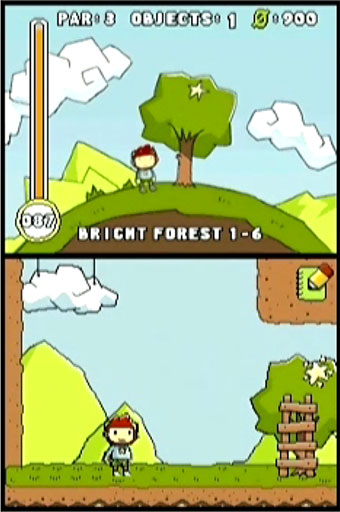
My biggest surprise of the show. Solve puzzles by willing object into existence merely by typing them. Reportedly has tens of thousands of words in it. Objects I was able to summon include (but are not limited to): a jetpack, a hot-air balloon, shark repellent, a shotgun, a chainsaw, a sawed-off shotgun, a wall, a T-rex, land mines, and almost every other noun I know. The only time I managed to come up with something that wasn't in the game was when zombies were attacking me, in order to make myself less desirable to them I tried to see if I could conjure AIDS. Didn't work.

-Trine:
The Lost Vikings meets LittleBigPlanet meets Bionic Commando. Trine is a 2D side-scrolling action/puzzler with a twist; you can play as three characters and toggle between them. The wizard can summon boxes, the thief can grapple, and the knight can fight. The thing that makes Trine really unique is that you can play up to three players co-op, but you cannot inhabit a character if another player is already playing as them. As a result, playing with three players can be even more puzzling as playing with just the one as you'll all have to work together to find a way to get the bulky knight across some gaps and over platforms. If you play as one character, however, you'll have all the abilities available to you, but can only use one at a time. As a result, the physics based puzzles take on a life of their own with multiple solutions based on how many players are involved, making it feel like a whole new game.

Bayonetta:
In some ways, Bayonetta may not represent the most innovative game at the show, as it falls firmly into the conventional mechanics of what a hack-and-slash game entails: Learn combos, fight demons (or renegade angels, rather), earn points for power-ups, collect stuff, fight bosses, etc, etc... But sometimes originality is overrated. If it ain't broke, don't fix it. I'm tempted to use the analogy Bayonetta is to the hack-and-slash game what Mario Galaxy is to the 3D platformer i.e. it doesn't innovate in its mechanics, but takes everything that was great about the genre and polishes it to a science, then fills it with a healthy dose style. If it lives up to the demo, it could well be the most fun, stylish, addicting third-person hack-and-slash game ever made. This honestly wouldn't surprise me as I feel like the first DMC hold up tremendously well today and Kamiya-san has had 8 years to hone his craft and do for the genre what DMC did for it nearly a decade ago.

-Shadow Complex:
2D Uncharted meets Metroid. The mechanics are quite similar to Samus Aran's glory years where you explore a staggering maze in a 2D side-scrolling plane, though the aesthetic shares are more in common with Uncharted (right down to the same voice-actor for the lead). You play as a guy trying to rescue his kidnapped girlfriend from a hidden military complex in the jungle. The vent-crawling and platforming is like Metroid to a T, but it also has glorious hand to hand combat with finishing moves shown in full 3D that look straight out of Uncharted. It's a bit of an unlikely mix of inspiration, but the result is truly wonderful.

-Mass Effect 2:
Looks a lot like its predecessor in many ways, but when its predecessor is one of the finest action-RPGs ever made, that's not such a bad thing. The thing that has me really intrigued is that you can reportedly go to the final mission rather early in the game, but you won't stand a chance. Instead, you'll have to travel the galaxies searching for soldiers to go on this supposed suicide mission with you. Depending on who you get to join you and how you treat them, this final mission can play out in a multitude of different ways. This has me very, very intrigued.

-The Saboteur:
Sly Cooper meets Okami meets Hitman in WWII. Playing as a hedonistic, womanizing, race-car driving rebel, you're on a quest for revenge that happens to have you killing lots and lots of Nazis. The game looks to be an even mix of stealth and action as you climb buildings, get the drop on enemies, place explosives, and make fast getaways. It's also one of the most stylish games at the show where occupied territory is portrayed in glorious black and white with some of the best rain effects I've ever seen. Once you clear the missions in an area, it goes back to being in color, not unlike rejuvenating the plants in Okami. It's about time we have a game about killing Nazis that really takes advantage of the beauty of that era.

-Sin & Punishment 2:
I never played the first one, but this was one of the most fun demos I had the pleasure to play at this year's E3. It's basically an on-rails third-person shooter, ala Star Fox, but better. At first the art style turned me off, but after playing it, I learned to really not care. Much like Bayonetta, this isn't innovative, but it takes what was great about oldschool arcade gaming and makes it even better.

-Silent Hill: Shattered Memories:
See here why Silent Hill never managed to really gel with me before. Shattered Memories seems to fix a lot of those issues with fluid controls, markers to show what items you can interact with, and nixes the dodgy combat in favor of some truly intense chases. Crashing through doors in this game reminds me of my very favorite bit of Mirror's Edge. I'm also intrigued by the psychological profile you take at the beginning and how it alters the experience. The only concrete piece of info I got was that it changes enemy appearance, so I'm hoping my arachnophobia makes the enemies spider-like. At any rate, it proved that a game can still be conventionally fun and still be scary as all hell.

-Alien Vs Predator:
A remake of a game I never played, but heard good things about. The behind closed doors demo I saw had you playing as a human, which should have been bland and like every other FPS horror in space shooter, but thanks to the aliens being a fantastic foe coupled with terrific lighting, poking around dark corridors using only your flare and flashlight to spot them sent chills down my spine. The bits I saw as Predator were even more interesting as you'd go from fighting the humans, picking them of stealthily one by one, to fast and furious combat with the aliens. The premise is silly and turned me off initially, but the concept of playing from hunter to hunted, to a neat little mixture of both looks to be a heckuva lot of fun.

Oh, and Uncharted 2 and God of War 3 looked fantastic, but I didn't bother to play them as they look like more of the first with better graphics. I liked their predecessors, so I'm sure I'll like them, just didn't feel compelled to try them, as I feel I know how they'll play already. But who knows? Maybe I'll be pleasantly surprised and they'll be even better than I'd thought.

Also, and I didn't include The Last Guardian only because it wasn't playable nor was any gameplay demo shown. When the trailer started running at the Sony Press Conference I got so giddy with excitement that I side-hugged my colleague next to me (poor Eddie). If more was known about this mysterious project, you could expect it near the top of my list. Same goes for Kojima's new Metal Gear and Castlevania projects.