Monday, June 8, 2009

Best of E3


I'm sorry I haven't updated this blog much lately, as I've been planning for E3, got side-tracked with even more work once there, then was away visiting friends in LA (but that's a whole 'nother story). At any rate, I would still like to write about inFamous a great deal (my review is coming soon to TGR), and perhaps write about the experience of going to E3, but there are only so many hours in the day. In the meantime, here's a list of the best games I saw at E3 2009 (in no particular order):

-Brutal Legend:
Tim Schaefer's wonderful humor is in top form here in this story of a roadie going back in time to an age when the Gods of Rock ruled all. The combat system, the one element I was skeptical about, turns out to be fast, fluid, and a whole lot of fun. It's basically Zelda, but with a guitar instead of an ocarina and rocks all the more because of it. Easily the funniest game I've had the pleasure of playing since Schaefer's previous outing, Psychonauts.

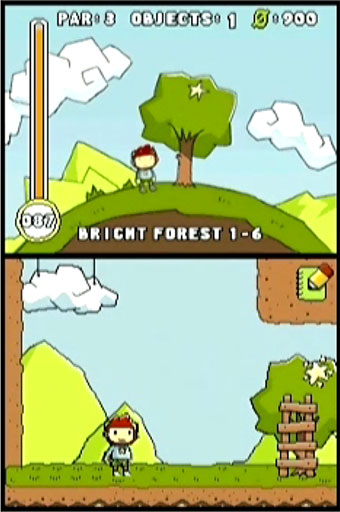
-Scribblenauts:
My biggest surprise of the show. Solve puzzles by willing object into existence merely by typing them. Reportedly has tens of thousands of words in it. Objects I was able to summon include (but are not limited to): a jetpack, a hot-air balloon, shark repellent, a shotgun, a chainsaw, a sawed-off shotgun, a wall, a T-rex, land mines, and almost every other noun I know. The only time I managed to come up with something that wasn't in the game was when zombies were attacking me, in order to make myself less desirable to them I tried to see if I could conjure AIDS. Didn't work.

-Trine:
The Lost Vikings meets LittleBigPlanet meets Bionic Commando. Trine is a 2D side-scrolling action/puzzler with a twist; you can play as three characters and toggle between them. The wizard can summon boxes, the thief can grapple, and the knight can fight. The thing that makes Trine really unique is that you can play up to three players co-op, but you cannot inhabit a character if another player is already playing as them. As a result, playing with three players can be even more puzzling as playing with just the one as you'll all have to work together to find a way to get the bulky knight across some gaps and over platforms. If you play as one character, however, you'll have all the abilities available to you, but can only use one at a time. As a result, the physics based puzzles take on a life of their own with multiple solutions based on how many players are involved, making it feel like a whole new game.

Bayonetta:
In some ways, Bayonetta may not represent the most innovative game at the show, as it falls firmly into the conventional mechanics of what a hack-and-slash game entails: Learn combos, fight demons (or renegade angels, rather), earn points for power-ups, collect stuff, fight bosses, etc, etc... But sometimes originality is overrated. If it ain't broke, don't fix it. I'm tempted to use the analogy Bayonetta is to the hack-and-slash game what Mario Galaxy is to the 3D platformer i.e. it doesn't innovate in its mechanics, but takes everything that was great about the genre and polishes it to a science, then fills it with a healthy dose style. If it lives up to the demo, it could well be the most fun, stylish, addicting third-person hack-and-slash game ever made. This honestly wouldn't surprise me as I feel like the first DMC hold up tremendously well today and Kamiya-san has had 8 years to hone his craft and do for the genre what DMC did for it nearly a decade ago.

-Shadow Complex:
2D Uncharted meets Metroid. The mechanics are quite similar to Samus Aran's glory years where you explore a staggering maze in a 2D side-scrolling plane, though the aesthetic shares are more in common with Uncharted (right down to the same voice-actor for the lead). You play as a guy trying to rescue his kidnapped girlfriend from a hidden military complex in the jungle. The vent-crawling and platforming is like Metroid to a T, but it also has glorious hand to hand combat with finishing moves shown in full 3D that look straight out of Uncharted. It's a bit of an unlikely mix of inspiration, but the result is truly wonderful.

-Mass Effect 2:
Looks a lot like its predecessor in many ways, but when its predecessor is one of the finest action-RPGs ever made, that's not such a bad thing. The thing that has me really intrigued is that you can reportedly go to the final mission rather early in the game, but you won't stand a chance. Instead, you'll have to travel the galaxies searching for soldiers to go on this supposed suicide mission with you. Depending on who you get to join you and how you treat them, this final mission can play out in a multitude of different ways. This has me very, very intrigued.

-The Saboteur:
Sly Cooper meets Okami meets Hitman in WWII. Playing as a hedonistic, womanizing, race-car driving rebel, you're on a quest for revenge that happens to have you killing lots and lots of Nazis. The game looks to be an even mix of stealth and action as you climb buildings, get the drop on enemies, place explosives, and make fast getaways. It's also one of the most stylish games at the show where occupied territory is portrayed in glorious black and white with some of the best rain effects I've ever seen. Once you clear the missions in an area, it goes back to being in color, not unlike rejuvenating the plants in Okami. It's about time we have a game about killing Nazis that really takes advantage of the beauty of that era.

-Sin & Punishment 2:
I never played the first one, but this was one of the most fun demos I had the pleasure to play at this year's E3. It's basically an on-rails third-person shooter, ala Star Fox, but better. At first the art style turned me off, but after playing it, I learned to really not care. Much like Bayonetta, this isn't innovative, but it takes what was great about oldschool arcade gaming and makes it even better.

-Silent Hill: Shattered Memories:
See here why Silent Hill never managed to really gel with me before. Shattered Memories seems to fix a lot of those issues with fluid controls, markers to show what items you can interact with, and nixes the dodgy combat in favor of some truly intense chases. Crashing through doors in this game reminds me of my very favorite bit of Mirror's Edge. I'm also intrigued by the psychological profile you take at the beginning and how it alters the experience. The only concrete piece of info I got was that it changes enemy appearance, so I'm hoping my arachnophobia makes the enemies spider-like. At any rate, it proved that a game can still be conventionally fun and still be scary as all hell.

-Alien Vs Predator:
A remake of a game I never played, but heard good things about. The behind closed doors demo I saw had you playing as a human, which should have been bland and like every other FPS horror in space shooter, but thanks to the aliens being a fantastic foe coupled with terrific lighting, poking around dark corridors using only your flare and flashlight to spot them sent chills down my spine. The bits I saw as Predator were even more interesting as you'd go from fighting the humans, picking them of stealthily one by one, to fast and furious combat with the aliens. The premise is silly and turned me off initially, but the concept of playing from hunter to hunted, to a neat little mixture of both looks to be a heckuva lot of fun.

Oh, and Uncharted 2 and God of War 3 looked fantastic, but I didn't bother to play them as they look like more of the first with better graphics. I liked their predecessors, so I'm sure I'll like them, just didn't feel compelled to try them, as I feel I know how they'll play already. But who knows? Maybe I'll be pleasantly surprised and they'll be even better than I'd thought.

Also, and I didn't include The Last Guardian only because it wasn't playable nor was any gameplay demo shown. When the trailer started running at the Sony Press Conference I got so giddy with excitement that I side-hugged my colleague next to me (poor Eddie). If more was known about this mysterious project, you could expect it near the top of my list. Same goes for Kojima's new Metal Gear and Castlevania projects.

Saturday, May 23, 2009

There is Love in Your Violence

Jack's got heart.

I keep coming back to Madworld.

Not even playing Madworld so much as thinking about it. The game has its share of design and mechanics issues, but I can't help but continue pondering this game.

The game's view on violence is an inherently fascinating one. Unlike most action movies and games that fetishize violence, only to then throw in some hackneyed politically-correct speech condemning it, Madworld realizes that violence, or at the very least witnessing violence, is a necessary, cathartic piece of the human condition. Violence as a spectator blood sport has been around since ancient times, and that's hardly changed today. We've simply honed it into an art form to create maximum violence at minimum risk i.e. professional wrestling, action movies, and in the case of MadWorld, a videogame. We, as a society (and perhaps as a species) crave to get out our aggression by either beating things to a bloody pulp, or watching others beat things to a bloody pulp. Madworld lets us get out our aggression without causing any harm to the real world. It's designed to embrace out inner violent tendencies, rather than judge them.

Jack is the perfect encapsulation of this. He is in essence, everything we want to be and don't want to be at the same time. He's gruff, violent, and borderline sociopathic (sure, he doesn't kill civilians, he does have a code after all, but mostly due to the fact that he likes a challenge). He's also cool, confident, and ready for anything. He's pure id; unsentimental to the core. He works for the "good guys" and takes out the "bad guys," but not due to any altruistic reasons, but rather as an excuse to hone his own violent tendencies. This, makes him an eerily unsympathetic character who we can't help but I identify with because all he wants to do is fight, and all we want to do it kill people in the most horrific ways possible (in game, mind you) i.e. play the game. He's also rather funny and charming, such as when he spanks a demon girl out a church's stained glass window. His self-assuredness makes him an oddly compelling role-model (note: do not try any of his actions at home). In short, he is the James Bond of snuff.

I keep coming back to a line of his near the end where his contact, a beautiful woman who you assume may be his romantic interest at some point, tells him to be careful. His response, "I've got a chainsaw on my arm. I'll be fine," something that never ceases to make me laugh. And in a way, we all have a chainsaw on our arm. Something great about ourselves that we tend to take for granted (in this case because the chainsaw is your default weapon that you can never lose). Personally, I found it a very inspiring bit of dialogue.

The game also has some interesting things to say about the nature of the government, pharmaceutical companies, and spectator sports in general. The idea of a government secretly holding bloodsports to finance itself, then using that money for the greater good is an inherently fascinating prospect. I'm reminded a bit of the ending of Watchmen (book or film. They're both thematically the same, if different in details). I'm not saying we should actually hold these bloodsports, but I think this conceit does a good job of reminding us that we are all to blame, on some level, for the state of affairs in which we live. We wouldn't have the luxuries we do if someone, somewhere wasn't being screwed by the companies and governments that keep us afloat. The game doesn't dwell on this too much, as that would make things into a rather somber affair. It's more along the lines of Starship Troopers where it's bright and cheery on the outside (complete with upbeat hip-hop music on the soundtrack and hilarious sports announcer commentary), but dig deeper and it's really some bleak satire, indeed.

Madworld may not be for everyone. The simple, repetitive nature of the mechanics may be enough to turn off a large portion of the fanbase that may otherwise be interested in such a narrative (an experience I've often shared with otherwise brilliant JRPGs). If you can get past those flaws, however, Madworld provides a unique artistic vision. It will make you feel terrible about yourself and the world, and then make you feel awesome. And for that, there is no greater compliment.

Tuesday, May 19, 2009

Trico Trailer Impressions


I have to admit my biases; Shadow of the Colossus is possibly my favorite game ever, and Ico is high up that list, so I've been waiting with bated breath for whatever masterpiece Fumito Ueda has been cooking up to be unveiled. Last year, E3 went by, and nothing. Then, Tokyo Game Show (where SotC premiered four years prior), and still nothing. Then, Ueda went on to speak at this year's GDC where everyone thought for sure his new game would be unveiled, and STILL nothing. All we had to go on was a job ad for his studio portraying a chain going down a hole. And now that they've finally released some actual footage of something, I have to say, I'm a little underwhelmed.

For starters, it looks a little too much like a mix of the previous two games with little originality emerging. The boy appears to be a dead ringer for Ico, and the creature bears a resemblance to a certain colossi. The fact that they're friends is new, but again, it looks a bit like Ico, where they swap Yorda for a colossus. Neither of these are bad things, exactly, just a little less than I was expecting.

Furthermore, the aesthetics looked quite a bit worse than what we saw in Ueda's previous games. I loved the simple, elegant cel-shading of Ico and Yorda, and the new fully 3D modeled character just doesn't resonate as well. He looks a bit blocky and goofy to me. The creature too looks a bit too clean and majestic; a bit at odds with the crumbling, ruinous tones of the world.

Speaking of the world, it looks very similar to what we saw in Ueda's previous two games, but perhaps a little too glamorous. For example, there are ruins, but they stretch out as far as the eye can see, which makes them appear a bit cluttered. As such, it lacks that lonely, minimalist, somber feeling that was so prevalent in Ico and SotC. The music, too, was a bit cheesier and more generic than what I'm used to from Ueda's games. It's like they took everything that was great about Ico and SotC and Disneyfied it (flashbacks to The Neverending Story certainly spring to mind. And apparently I wasn't the only one who though that, according to my mates on Twitter). Then again, there's no telling if that's the final music (or character models, or anything, really), so that could all likely change, or at the very least, make more sense in the context of the final product.

Obviously, I'm a bit biased, as I had unreasonably high expectations, and was disappointed. That being said, I'm sure the final product will be amazing nonetheless. Even if it does look too much like a retread of his previous two games, that's still a world that I love and wouldn't mind going back to. And as far as it being a cliched story of a boy befriending a giant goes, I must say that one of my favorite films of all-time is The Iron Giant (and I recall recoiling in horror at the trailer for that movie as well), so this could well be absolutely amazing. I was particularly intrigued by the shot of the creature swimming through a tunnel with arrows jutting out of its back, implying a level of violence only hinted at here, but will be made apparent later.

Make no mistake, I'm still woefully excited about this game. Even if I found that this particular teaser trailer fell a bit short of my expectations.

Edit: After watching the trailer a few more times, I've come to the conclusion that the creature looks great, but the kid still looks pretty bad. Notably his cartoon face in full HD, which just looks a bit silly. Here's hoping they fix that before the final build.

Sunday, May 17, 2009

Uncharted 2: Who is This Chloe Girl and What Have You Done With Elena?


I've seen the footage of Uncharted 2 and while in many ways the game looks to be shaping up nicely, one thing has me concerned; what the fuck happened to Elena? She was one of the best female supporting characters I've seen in a game, so it seemed troubling to nix her in favor of this year's new model. The more I thought about it, the more this seems to be a troubling trend of the action/adventure genre in general, where we're given a lead male character and a new romantic interest in each adventure. James Bond and Indiana Jones certainly come to mind. While it's been suggested that Uncharted swaps romantic interests as its primary influence is, of course, Indiana Jones, I'm not convinced that argument carries much weight, as I think just about everyone would agree that Marion Ravenwood from Indy's first outing was, and always has been, the best quasi-romantic partner for the tomb raiding archeologist. Elena, from the first Uncharted, was a fantastic character as well. Unafraid to jump right into the thick of action, and quick-witted enough to fend off Nathan's Han Solo-esque advances, she was just the kind of spunky, deadly, improvisational badass you would want from a girl to fight pirates with. Replacing her sounds not only misogynistic, but flat out at odds with arguably the thing that made Uncharted most charming; its characters.

While swapping female romantic interests has been a disheartening trend in the industry (and films and books before that), I'd point to something like Sly Cooper as an example of how to do it right. In those games, Sly always had the hots for a certain foxy detective (pun fully intended. Sorry), who was always on his trail. Of course, they could never be together as she'd have to bring him to justice, but their endlessly flirtatious rivalry sizzled, lasting an entire three games. The conclusion of the third game, which I won't dare give away here, found a brilliant way to get around their stalemate, and still leaves room for the inevitable Sly 4.

The influences here are a little different, as Uncharted basis itself on old adventure serials, and Sly on Saturday Morning Cartoons, which required that they keep the same cast for long periods of time (though strangely, they had to replace the voice-actor for Carmelita Fox with each of the three games, which was unfortunate. I'm not sure what the reasoning was behind this, but I'm going to assume that they would have liked to have kept the same actress all along, as it is the same character, after all). Though I believe Sly did things right, and Uncharted could learn from it. Maybe I'll get lucky and be proven wrong and they're keeping Elena a surprise for when the games comes out, which would be kind of awesome. But until then, I'm a little perturbed by the second-hand treatment women are given in these games, and hope to see a change soon.

Saturday, May 16, 2009

Bioshock 2 Developer Demo Impressions


I have to admit that I was extremely skeptical of Bioshock 2, as I felt the first one was a fully self-contained game. Furthermore, I felt that it was a game that had worn out its welcome in the final quarter. So when Bioshock 2 was announced, it sounded a bit like a heartless cash-in. This was confounded by the first look we saw of the concept art for the Big Sister model, which I thought missed the point spectacularly. The Big Daddies were iconic. Bulky, lumbering men in turn of the century diving suits. An icon we’ve all seen before. The Big Sister model just didn’t make much sense. It’s a bulky lumbering diving suit that’s also trying to be curvy and voluptuous? Looked more like a cyborg ninja to me, and at odds with the more understated, realistic tones of the first game. Thankfully, after seeing the above nine minute developer demo, I have been completely turned around on this sequel and am very excited indeed.

The first thing I noticed was that since you play as a Big Daddy this time around, enemies don’t pose as much of a threat. In terms of conventional game design, this should be a bad thing. We’ve been trained to think of combat in games as something difficult that one must overcome, but that is not the case here. In Bioshock 2, you play as the ultimate badass and the game knows it. Rather than just launch a horde of cannon fodder at you as you tear them to shreds, the enemies react realistically to your presence and will gang up on you in groups before fleeing when the going gets tough. My favorite moment in the trailer was after the player murdered a group of splicers, then queued up his drill at the sole survivor ran away in horror. I’ve seen enemies fall back behind cover before, but to see one who wants to retreat from the fight entirely--and in response to your drill revving--was a sight to behold and gives the player a sense of empowerment that I’m not sure I’ve seen in a game before. This may diminish the sense of challenge from the game’s combat, but I don’t believe that challenge was ever the focal point of the first Bioshock or the direction that the series should take.

Since Bioshock was such an immersive cinematic experience that already had no loss condition due to its vita-chambers, it makes me wonder what you could do with a game that features easy combat that only exists to add drama to the proceedings. As an action game, this wouldn’t work, but for a game that focuses on exploration, choices, puzzles, and narrative, I’m surprised that this hasn’t been done before. I’m not saying Bioshock 2 will be that game--as there will still be challenges in the form of the Big Sister--but this looks like a nice first step towards an interesting new direction for combat in gaming.

Read the rest of my impressions at TGR.

Monday, May 11, 2009

Big Red Potion Episode # 12; Afterword


My appearance on the new episode of Big Red Potion is up in which we discuss Death in Gaming. Despite some technical difficulties, I think we all had a great time recording and covered a lot of interesting ground. Give it a listen!

Here are some of my thoughts after suffering through listening to my own voice:

I think Sinan really hit the nail on the head, when he said so-called "gamey" games need some kind of loss condition, whereas if a game is meant to be more of an experience, death is seen as an impediment. I cited Zack and Wiki on the show, but upon further reflection, a greater example of this would be the Phoenix Wright series. Those games are essentially digital graphic novels and the fact that there even is a loss condition at all impedes their pacing tremendously. If you lose a case, you'll be sent back to the beginning of the chapter, which can take several hours of skipping through text to get back to where you were. Of course, no one ever actually loses those games as you can save at any time (unless you're unfortunate enough to save right before losing your last point), so it's baffling why they even bothered to allow you to lose in the first place. It would work infinitely better if the judge simply continued shaming you when presenting the wrong piece of evidence, so you could stay in the game at all times, worry free, as it would just be a shortcut to having to save and reload all the time. I don't wish to make broad generalizations about an entire nation, but Japan does have a reputation for being a little less progressive in game design on the whole. I find that having game-overs in Phoenix Wright (and Zack and Wiki) to be remnants of this oldschool design philosophy unceremoniously placed unto a a genre that never needed it (just look at the old LucasArts adventures, as Joe wisely noted).

To elaborate on my point about JRPGs- I don't believe the genre shouldn't feature death. The genre has its inheritance in pen-and-paper games, which are very "gamey" by nature, so they require a loss condition. What I meant was that I wished RPGs let you keep all your loot and exp, so it wouldn't make you feel like the last half-hour plus was all for naught upon dying. Or perhaps just have an option as to whether to keep all your exp, as I dislike the idea of the game making itself easier in case the player may not want that. Again; different variables based on how hardcore an experience the player wants. I disliked the gamey aspects of Persona 4, but otherwise liked the experience and just wanted to press forward. Others may want a stricter challenge. I think there may have been a little confusion as to what I was talking about there.

Going with the idea of varying levels of entry, Steve had a fantastic suggestion that we discussed the night before, then absent-mindedly forgot to bring up on the show. Since he doesn't have a blog of his own, I will surmise it here: He suggested that certain games maybe not have a game over, but rather a ranking system to show how many times you "died." Something like Ikaruga comes to mind where you can unlock infinite lives after a certain amount of play, but if you really want to achieve high score status, you'll have to get especially skilled at the game. I've found that Geometry Wars 2 does an amazing job at making a single-player experience social via its friends only leaderboard. Imagine if a game like Uncharted had no death penalty, which would quasi make sense as it's such a narrative-based game and a lot of players may just want to play it for the story (though they'd have to come up with some ridiculous reason for why Nathan could constantly be resurrected), yet it could offer great incentives for replay value if you could replay individual chapters for high scores based on number of times "killed," headshots, time completed, etc, etc...

At any rate, I hope you all enjoyed the podcast and I'd be curious to hear other opinion on ways that death can either help or hinder a certain type of game.

Tuesday, May 5, 2009

Rise From the Ashes


I don't often write about a game before it's released as I feel like there's way too much of that already (and then a game gets a measly one-off review and is never heard about again, in most cases), but I felt compelled to write about InFamous.

With all due respect to the fine folks at Sucker Punch, there is no way your game is going to live up to the game I've envisioned it being in my head. Let's start with the concept:

You're a regular guy inexplicably given superpowers during a cataclysm that decimates the better part of a metropolitan city, leaving the remnants a quarantined, lawless dive. Think hurricane Katrina with less water and more electricity. We've seen more than our fair share of post-apocalyptic cities in videogames over the years, so at face value, the thought of another one does little to stir the imagination. But this isn't a Big Brother/1984 rip-off like Final Fantasy VII, Crackdown, Madworld, or the Fallout series. From what I gather, there is no organization in charge. This is pure anarchy. Generally speaking, having super-powers makes one either a crime fighter or an outlaw. Here, however, there is no established order. You don't revolve around civilization. Civilization revolves around you. That makes you the shape of things to come. A heavy burden indeed.

It's not a "god game," though. Unlike a strategy game like Civilization or Black & White, here, you play a particular role. You're a person. As such, you have needs. You'll have loved ones who you'll want to protect, which may be at odds with performing your duties at establishing order amidst the chaos. I've heard of scenarios where you'll have to decide whether to horde rations of food for yourself and your girlfriend, or distribute it equally amongst the citizens. This sort of situation really appeals to me in this current wintry economic climate. If this were happening to me in real life, I don't know that I'd have the will to resist skimming a little off the surface for myself and my loved ones. InFamous, at its core, could prove to be amongst the greatest tests of mankind's true nature.

I know that's a ballsy statement to make, and I'm aware that there have been lots of games to give you these binary good/evil choices, but I often find myself less drawn into their scenarios and don't play the way I would if I were encountering such situations in real life. In Fallout 3, for example, it was fun to occasionally kill a random wayfarer and take his loot. I'd argue that murdering civilians was the highlight of an GTA game. Fable 2 started strong, but after its opening hour they sort of dropped the ball on storytelling and it became rather silly with its silent protagonist, lack of memorable NPCs, and I think most people would agree that the game was at its most fun when you'd mischievously break the rules and say, murder your family. None of those games were representative of me as those games didn't make me care about the people in it. The best example I can think of so far where a game gave me moral choices and I cared about those choices beyond whatever stat boosts they'd garner me, was Mass Effect. I liked that universe and I liked my crew. I wanted to do good by them. But again, Mass Effect had an established order. You could only effect the status quo so much by either saving the galaxy, or saving the galaxy and putting humans in charge. Oh kay then...

InFamous also makes being evil tempting for all the right reasons. In a lot of games, I'll be a dick, simply because I can. Because it's funny and the world lacks character, so it feels like playing army men. But in InFamous, the concept of being evil is tempting because you could quite possibly rule this place as a dictator. Well, maybe. I'm not sure if the game will go that far or not, but I sure hope it does. Sure, murdering civilians in GTA is fun for awhile, but ineffective in the long run. The idea of having a whole city move to your whim is certainly a compelling notion. Or maybe not even a dictator, per se, but even just a high class criminal who people will not want to mess with would prove to be an enviable enough role. Either way, being evil seems like it would net rewards and I really hope the game doesn't cop out the way Bioshock did and give you at least as many rewards for supposedly altruistic choices.


Early previews have suggested that Cole is somehow responsible for the cataclysm that destroys the city, yet gives him super-powers. This has me extremely intrigued as I like the idea of a superhero who has the deaths of thousands on his conscience. I can't help but revel in the irony that his accidentally massacre is also what leads to him having powers and could shape him into a hero. For anyone who's watched Battlestar Galactica and found themselves oddly compelled to root for Gaius Baltar, InFamous may be just the game we've been waiting for. I just hope against hope that they don't cop out here and have some stupid revelation that it wasn't you after all. Or worse, was some already "evil" dude they could use as a scapegoat.

While the premise has me really intrigued, I'm also quite confident the game will be a heck of a lot of fun to play as it looks to control quite a bit like Sly Cooper (my favorite 3D platformer series), and the art style seems to really "get" the whole superhero thing. It's a bit goofy, but it's serious kind of goofy, like X-men. The powers are silly, but the situations feel grounded. I'm particularly intrigued by Cole's electric powers. A lot of people felt like having only one kind of power might limit the game, as something like Bioshock gave you such things as fire and ice to play with as well, but from what I gather, there will be a lot of variety to his electric powers. Plus, superheroes always have just one power (plus the standard heightened dexterity and jumping), so it's in keeping with the concept. And the fact that Cole's electric powers prevent him from using guns in a masterstroke. I think I speak for a lot of gamers when I say that I'm starting to get a little weary of guns these days.

While I have ridiculously high hopes for this game, there are still some things I'm a bit skeptical of. Notably, the script. Given that Sly Cooper's writing and characters were some of the best I've ever seen, I remain hopeful. Though, based on what I've seen so far of Cole, he looks and sounds a bit bland. And his sidekick buddy Zeek looks a little too goofy. Murray the hippo worked in Sly Cooper, but I'm worried a character like that might feel a bit too silly and forced in this setting. We've seen surprisingly little of the characters so far, but it remains one area where I only have good faith to go on. So here's hoping.

Even if InFamous can't possibly live up to its full potential (or perhaps will, and blow all of our minds) it will at the very least be one of the most compelling premises I've seen for a game in a long, long time. And that, my friends, has me very excited, indeed.